Offer
Provide additional details about the offer you're running.
FLASHSALE

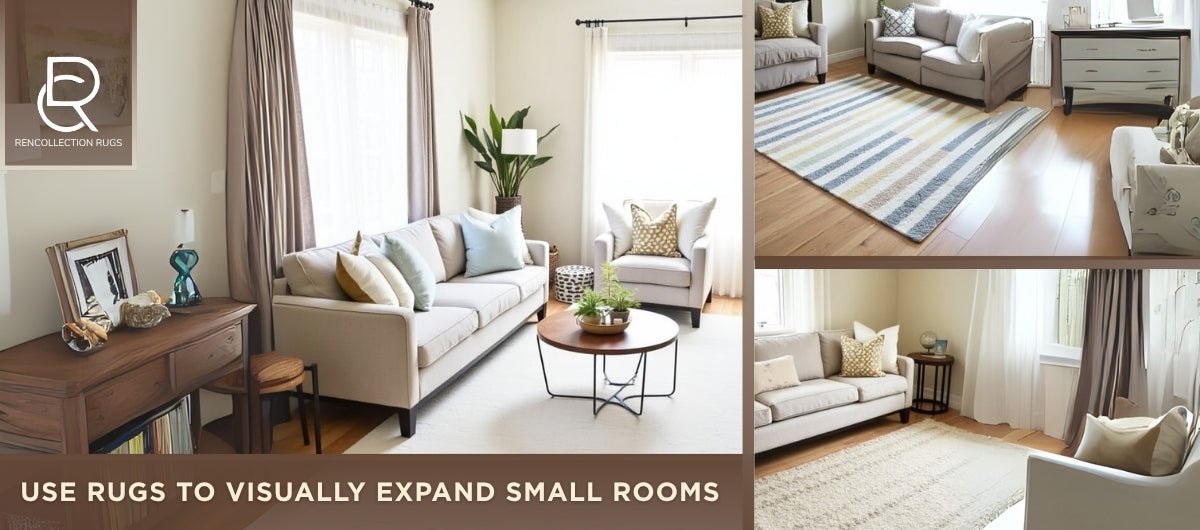
If you have a small space, it doesn’t mean you have to sacrifice your style and comfort. Even the tiniest room can appear spacious and airy by using some clever design tricks. What is the most powerful (and often underestimated) tool at your disposal? Rugs. Not only do these comfortable and versatile items provide warmth and protect your floors, but they can also completely transform the perception of space in a room. Here’s a strategy you can use to create bigger, brighter, and better-balanced rooms by making your small spaces look larger with the help of rugs.
Contrary to common opinion, a small rug in a small room helps to shrink the area even more. When a rug is too small, it visually chops up the floor, and the attention is drawn to the cramped size of the room. Instead, consider a bigger rug that will run under pieces of furniture. Ideally, the rug should have all the front legs of your main furniture placed on it.
In one of the rooms, such as a living room, the rug can expand under the sofas, coffee table, and couches. In a bedroom, the rug should support the bed and extend at least halfway underneath the furniture. This approach creates a unified base that grounds the space, giving the illusion of a more spacious feel.
Color is essential in creating space. Light-colored rugs—such as whites, creams, beiges, or pale grays—reflect more light and give a breezy look to a room. On the other hand, darker rugs absorb light, making the space appear smaller.
Research lightweight patterns on a white rug that incorporate neutrals with neutral tones, along with soft pastels or gentle geometric designs. They add character without overwhelming the eye. The goal is to keep things visually open and to avoid anything too heavy or saturated in tone.
Stripes are one of the oldest tricks in the design book for changing perception and look amazing on the floor. Horizontal stripes can make a narrow room appear larger, while vertical stripes can lengthen a short room. Orientation is crucial; place a striped rug with the stripes oriented away from the direction you want the room to be extended.
The trick is ideal for corridors, smaller dining rooms, or compact living spaces. To match the contemporary aesthetic, bold black and white stripes are suggested. For a calmer vibe, look for tonal rugs that are hand-woven with subtle linear patterns.
Patterns can add life and complexity to a room, but in a small space, excessive graphic variety may become overwhelming. It all depends on moderation. Avoid rugs that are too busy and choose instead those with modest, clean designs like geometric patterns, small floral prints, or airy abstract patterns.
Stacking rugs is a clever way to create visual interest and depth. Start with a larger, neutral base rug and place a smaller, more decorative rug on top. This method is rich in detail and prevents overcrowding in the space.
For instance, imagine a vintage Kilim or Moroccan rug layered over a large jute or flatweave rug. The neutral base layer grounds the space, while the pattern and color of the top rug are added in a controlled manner.
Rugs are effective design tools that can make your small spaces appear larger, create distinct areas, and add comfort and personality to your home. By considering size, shape, color, and placement, you can easily transform the appearance and feel of a room more than you might expect. The next time you feel cramped, forget about knocking down a wall and simply roll out the right rug.


Enjoy an exclusive 5% discount on your first order as a warm welcome from us. Add beauty and comfort to your home—shop now and save!

