Offer
Provide additional details about the offer you're running.
FLASHSALE

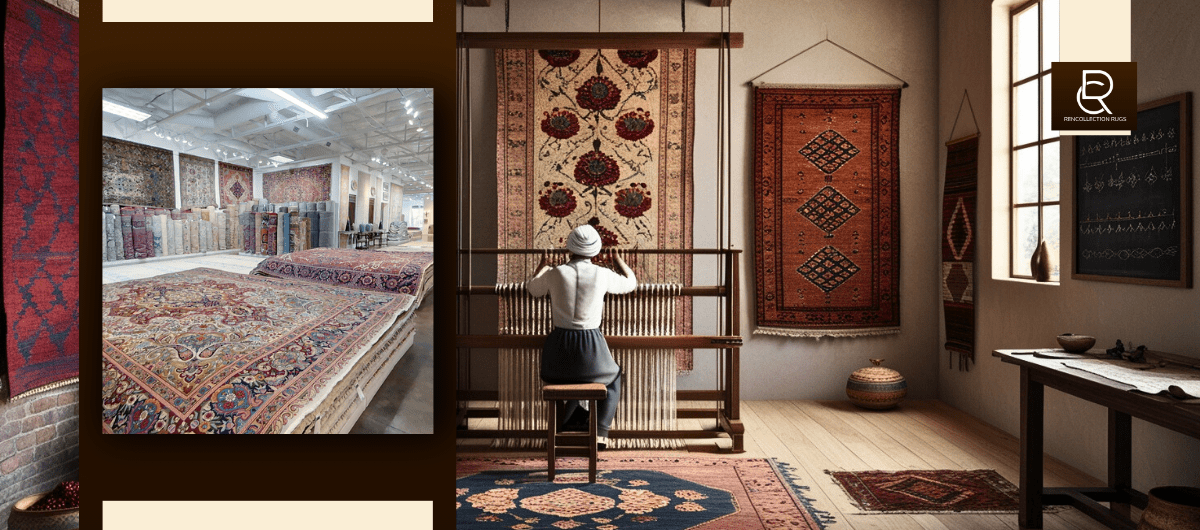
If you look at a striking rug with lots of detail and texture, it’s not only a floor covering you are seeing. You are walking on a work of art. Rugs have been valued for more than their usefulness for a long time. Rugs have long been considered more than utilitarian objects, they show culture, history and craftsmanship.
But the question is, what makes a rug rise beyond being a home accessory to being called a work of art? Let’s discuss the elements that turn a rug into a masterpiece, starting with the craftsmanship involved and ending with what each rug tells us without words.
The world’s greatest rugs all have a common feature: they are made by hand. While machines make rugs focus on similar patterns, handmade rugs are unique because of the skill and patience of those who create them. It can sometimes take a lifetime to finish certain pieces because weavers tie thousands of knots each day. People appreciate classic Persian, Indian, Turkish and Moroccan rugs because of their high quality in craftsmanship and lifespan. All knots are intentional movements in a dance. There are many cases where each square inch of a textile is packed with hundreds of knots, proof of the weaver’s ability.
Both the materials and how they are woven play important roles in making a great rug. Most high-quality rugs are made with wool, silk or cotton. Wool is tough and warm, silk is elegant and shiny and cotton serves as a strong foundation. Masterpiece rugs stand out because not only do they use top materials but also because of how they are obtained and cared for. Synthetic yarns cannot give the same intense colors and rich textures you find in hand-spun wool dyed from plants. Over time, these natural dyes fade into softer hues which gives them a special effect that cannot be duplicated.
Color is a powerful emotional feature of a rug. Rugs made using traditional methods are colored with dyes made from plants or insects to get amazing shades of indigo, madder red, saffron yellow and pomegranate brown. These colors catch the eye and have considerable historical importance. Die makers use their artistic skill to dye fabrics. To be a good dyer, an artisan should know the soaking time, the ingredients to use and how the dye will change over time. Throughout the world, certain colors also hold symbolic meaning. Having red colors can bring you fortune and happiness, while blue helps hide from evil entities
A well-made rug can store a lot of visual history. What’s found in the patterns and motifs is often a representation of the culture, religion and beliefs of the artists who made them. One example is that Persian rugs usually have intricate floral medallions, whereas Turkish rugs display big geometric shapes. Often, nomadic tribes are known for weaving pictures of fertility, shielding or earthly symbols. A rug becomes a masterpiece when it is both beautiful and has real meaning and significance for a culture. Such designs are handed down over generations, with some changes, but always for a specific reason.
One of the most endearing qualities of a handmade rug is its imperfections. The human hand is not a machine. A line may be slightly uneven, or a motif may be asymmetrical. These subtle irregularities are not flaws; they are signatures. They are what tell you the rug was made by a person, not programmed by a computer.
In fact, some weavers intentionally add what’s known as a “Persian flaw”, a minor imperfection as a mark of humility, acknowledging that only the divine can achieve true perfection.
Rugs that are true masterpieces only get more valuable as time goes on. Eventually, good quality rugs will produce a soft shine called a “bloom,” and their colors will blend together in a soothing way. Antique rugs are valued not only for looking good but for lasting a long time. People who collect and those who work in interior design both value the character of older rugs. Over the years, photographs show signs of time passing and feel more special. The edges, patterns and threads show the rug has traveled a lot and is still here.
Finally, what makes a rug a masterpiece is the feeling it evokes. Much like standing before a great painting or sculpture, encountering a remarkable rug can stir emotion. It can make a space feel grounded, vibrant, serene, or storied. It captures attention without demanding it. It becomes the soul of a room.
A rug masterpiece is not simply something you step on. It’s something you experience. It carries within it the history of a people, the soul of an artist, and the patience of a craft perfected over centuries. When you invest in such a rug, you’re not just buying decor. You’re preserving a tradition, owning a story, and welcoming a timeless piece of art into your life, quite literally, beneath your feet.


Enjoy an exclusive 5% discount on your first order as a warm welcome from us. Add beauty and comfort to your home—shop now and save!

